No
Acknowledgement
The Nebraska Department of Health and Human Services (NDHHS) makes best efforts to ensure the accuracy of all data collected, stored, analyzed, and reported from its databases. By using this dashboard, users acknowledge the above limitations, and that the data are subject to continuous updating. Results within this dashboard may not be identical to previously published results.
Background
State of Nebraska statutes require that records of birth, death, fetal death, marriage, and divorce that occur in Nebraska be filed with the Office of Vital Records of the NDHHS Division of Public Health. Records of events for Nebraska residents which occurred in other states and territories, and which the Department receives through an Inter-Jurisdictional Exchange Agreement, are also included in Nebraska vital records.
This dashboard includes information from birth certificate records for Nebraska residents for 2005 through the most recent available year. Births that occurred within Nebraska to non-Nebraska residents are not included in the data presented. Births prior to 2005 were recorded using a different version of the birth certificate and are not included.
Natality data are based on county-level reporting of nationally standardized birth records. Certified birth certificates with parental information and basic demographics are used for purposes such as providing proof of citizenship and obtaining records such as a driver's license, a Social Security card, and collecting retirement benefits. Additional medical and health information on the mother and child is reported in a longer form and stored in Vital Records databases.
The accuracy and completeness of these records depend on the reporting parties. Final data files are generated annually for statistical reporting, which were used to populate this dashboard. Once the files are finalized, newly filed and amended records are not added to these data files, and subsequently not reflected in this dashboard.
Dashboard Filters
This dashboard allows results to be filtered by geographic and demographic characteristics.
Geographic Characteristics
Results can be filtered by two geographic classifications: the State of Nebraska overall and individually for each of the state's 19 local health department (LHD) regions. The following map identifies the counties included in the LHD regions.
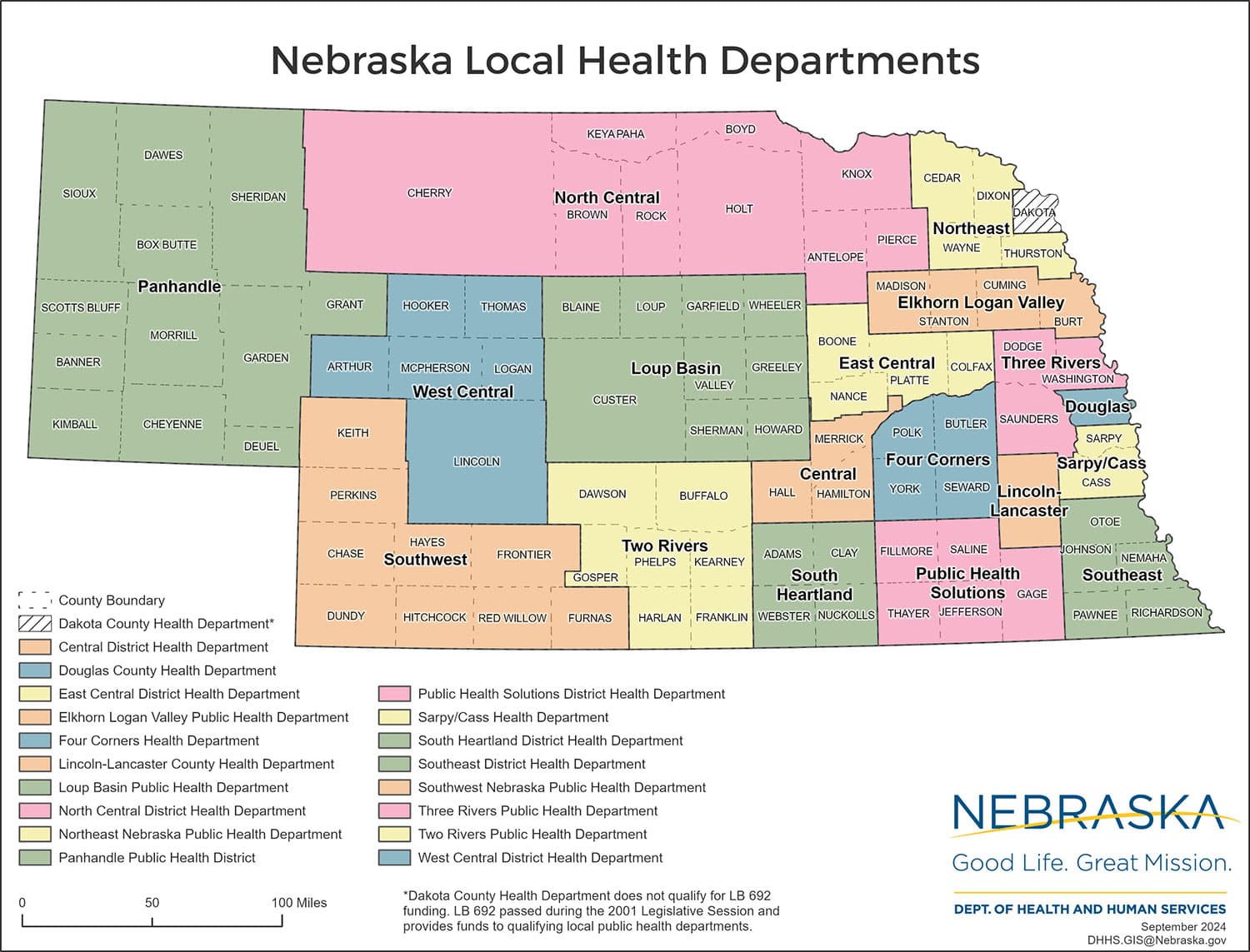 View the accessible PDF.
Urban/Rural
Results can also be reported by the degree of urbanization of the deceased person's county of residence. While there are numerous ways to define urbanization, three categories are included within this dashboard. These categories are based on “Reporting Category 1" within the
Disparities Demographic Data Recommendations Report, Division of Public Health, NDHHS, November 2016. The counties included within each category are grouped and labeled as follows:
Urban‐Large (7 counties)
Cass, Douglas, Lancaster, Sarpy, Saunders, Seward, Washington
Urban‐Small (15 counties)
Adams, Buffalo, Dakota, Dawson, Dixon, Dodge, Gage, Hall, Hamilton, Howard, Lincoln, Madison, Merrick, Platte, Scotts Bluff
Rural (71 counties)
Antelope, Arthur, Banner, Blaine, Boone, Box Butte, Boyd, Brown, Burt, Butler, Cedar, Chase, Cheyenne, Clay, Colfax, Cuming, Custer, Dawes, Deuel, Dundy, Fillmore, Franklin, Frontier, Furnas, Garden, Garfield, Gosper, Grant, Greeley, Harlan, Hayes, Hitchcock, Holt, Hooker, Jefferson, Johnson, Kearney, Keith, Keya Paha, Kimball, Knox, Logan, Loup, McPherson, Morrill, Nance, Nemaha, Nuckolls, Otoe, Pawnee, Perkins, Phelps, Pierce, Polk, Red Willow, Richardson, Rock, Saline, Sheridan, Sherman, Sioux, Stanton, Thayer, Thomas, Thurston, Valley, Wayne, Webster, Wheeler, York
Demographic Characteristics
Age
Results are reported across five age categories based on the mother's age in years, including less than 20, 20-24, 25-29, 30-34, and 35+, for the characteristics of mother, pregnancy, and birth. For birth rate, six age categories are reported and based on the mother's age in years, including 15-19, 20-24, 25-29, 30-34, and 35-39, and 40-44.
Sex
Baby names are reported by infant sex.
Race and Ethnicity
Race and ethnicity are separate concepts and fields on birth certificates; however, for this dashboard, mother's race and ethnicity are combined into six categories for reporting. These categories include White, Non-Hispanic (White, NH); Black or African American, Non-Hispanic (Black, NH); Asian, Native Hawaiian, or other Pacific Islander, Non-Hispanic (Asian/PI, NH); American Indian or Alaska Native, Non-Hispanic (American Indian, NH); More than one race, Non-Hispanic (Multiracial, NH); and Hispanic or Latino, regardless of race (Hispanic). Individual results are suppressed for Other Race, Non-Hispanic due to small numbers. For this dashboard, infant race/ethnicity is derived from the mother's race/ethnicity.
Year
Results can be reported for a single year or a specified range of years. Data are available for 2005 through the most recent available year.
Dashboard Statistics
The following statistics are presented in the dashboard:
Number
The number of births overall or for the selected year(s), geographic region, demographic population, characteristics of mother or pregnancy, or by baby name.
Percentage
The number of births divided by the total number of births for the selected year(s), geographic region, demographic population, or characteristics of pregnancy/birth.
Rate
The birth rate for the selected year(s), geographic region, and demographic characteristic are reported. The birth rate is defined as the number of births divided by the population for the selected year(s), geographic region, or demographic characteristic, then multiplied by 1,000 to obtain the birth rate per 1,000 population.
Data Suppression
To protect the privacy and security of the data presented within the dashboard, the number of cases or records are suppressed (not shown) using the following rule: (1) when the count is 1-5, or (2) if only one category is suppressed the next lowest category is also suppressed in instances where the count could be identified through subtraction. Furthermore, data are reported geographically down to the local health department level but not to smaller geographic regions.
Missing/Unknown Data
Some birth certificate records do not provide complete data. For example, the race/ethnicity or the characteristics of birth (e.g., delivery method) may not be documented on the birth certificate. Footnotes are included within the dashboard providing information on missing data.
Data Use Limitations
Many geographic areas and demographic groups in Nebraska have small populations. As a result, wide variation in the number of births can occur from year to year, and no single year may be truly representative of the population over time. Combining multiple years of data may improve the stability of estimates.
Census Population Data
Data from the Census Population Estimates was used as the denominator to calculate the birth rates presented in this dashboard. The population figures for the years 2005 through the most current year were obtained from the Annual County Resident Population Estimates by Age, Sex, Race, and Hispanic Origin files available on the U.S. Census Bureau website. The population data for 2021 and later is updated annually, meaning the estimates may change slightly each year. As a result, birth rates could fluctuate year-to-year based on these updates.
Characteristics of Pregnancy and Birth Indicator Definitions
Parity
Parity is the number of times a person has given birth to a live infant. For example, parity for someone who has given birth to one live infant is 1 (one). Parity for a person who has given birth to a set of live twins also has a parity of 1 (one).
Plurality
Plurality is the number of births from a single pregnancy. A pregnancy resulting in one birth is also called a singleton birth. Other examples of plurality include twins, triplets, and other multiples.
Smoking Status
Maternal smoking status is defined as any reported smoking during pregnancy, regardless of trimester.
Pre-Pregnancy BMI
Pre-pregnancy Body Mass Index (BMI) is a measurement of a mother's weight in relation to their height, prior to pregnancy. Those in the Underweight category have a BMI <18.5; Normal Weight is between 18.5-24.9; Overweight is between 25 and 29.9; and the Obese category is a BMI of 30 and above.
Hypertension
Hypertension is diagnosed when someone has high blood pressure at multiple readings. Hypertension can occur before pregnancy or be diagnosed during pregnancy (gestational hypertension).
Diabetes
Diabetes is diagnosed when someone has high blood glucose, sometimes called blood sugar. People can be diagnosed with diabetes before pregnancy or during pregnancy (gestational diabetes).
Previous Preterm Delivery
A previous preterm delivery is when a mother delivered another baby before 37 completed weeks gestation in a previous pregnancy.
Adequacy of Prenatal Care
Adequacy of prenatal care is defined using the Kotelchuck Index, a standardized measure that evaluates both the timing of initiation and the intensity of prenatal care. This index compares the actual number of prenatal visits to the recommended number, adjusted for gestational age at the first visit and the gestational age at delivery.
The index classifies care into four categories:
- Adequate Plus reflects a higher frequency of visits than the standard recommendation.
- Adequate care generally signifies initiation in the first trimester and adherence to recommended visit schedules.
- Intermediate care falls between the Inadequate and Adequate categories.
- Inadequate care typically indicates initiation of care late in pregnancy, substantially fewer visits than recommended, and/or no prenatal care.
It is important to note that the Kotelchuck Index focuses on the quantity of visits and may not fully capture the quality of care received. The index is based on recommendations for low-risk pregnancies, and therefore may not accurately reflect the adequacy of care needed for women with high-risk pregnancies or pre-existing conditions.
Trimester of Prenatal Care
The trimester of prenatal care initiation notes the timing of the first prenatal care visit. First trimester means the visit occurred before 12 completed weeks of pregnancy, second trimester means the visit occurred between 13 and 27 completed weeks of pregnancy, and third trimester means the first visit occurred at 28 completed weeks or later. No prenatal care means the birth certificate indicated that the mother did not complete any visits to a prenatal care provider during the pregnancy.
Birth Weight
Birth weight is the weight of the baby at time of birth in grams. A baby weighing less than 1,500 grams is considered “very low birthweight", between 1,500 – 2,499 grams is “low birthweight", between 2,500 – 3,999 grams is “normal birthweight", and more than 4,000 grams is considered “high birthweight."
Breastfeeding at Discharge
This indicator denotes if an infant was being breastfed at time of discharge from the birth hospitalization.
Delivery Method
Vaginal delivery method is when someone gives birth vaginally. A primary c-section (cesarean section), occurs when someone gives birth via c-section for the first time. A repeat c-section is when someone gives birth via c-section and had a previous c-section.
Delivery Payment Source
The payment source listed on the birth certificate can be listed as private insurance, typically through a commercial insurance provider through an employer's plan; self-pay, sometimes called paying out-of-pocket; Medicaid; or all other payment sources, for the instances where the payment source was not one of the other options.
Gestational Age (Term)
A birth is full term if it occurs at 37 completed weeks of gestation or later and preterm if it occurs prior to 37 weeks completed gestation.
Gestational Age (In Weeks)
Gestational age in weeks is the number of completed weeks of gestation when an infant is born.
Additional information about Nebraska Vital Records and Vital Statistics can be found on the following websites: Nebraska Vital Records and Nebraska Vital Statistics.
Contact